Sunday 16 November 2025
Cosmologies and Liquid Futures with Paola Estrella
Last year, artist Paola Estrella took part in our Artists Make Space programme. The programme gives free studio space to local artists. Paola used her time in the studio at Orleans House Gallery to create and rehearse a multi-media performance as part of her Cenote Ring project. The performance then took place at Stone Nest in central London. A video of the performance now accompanies an installation of Cenote Ring paintings, on view at HS Projects until December.
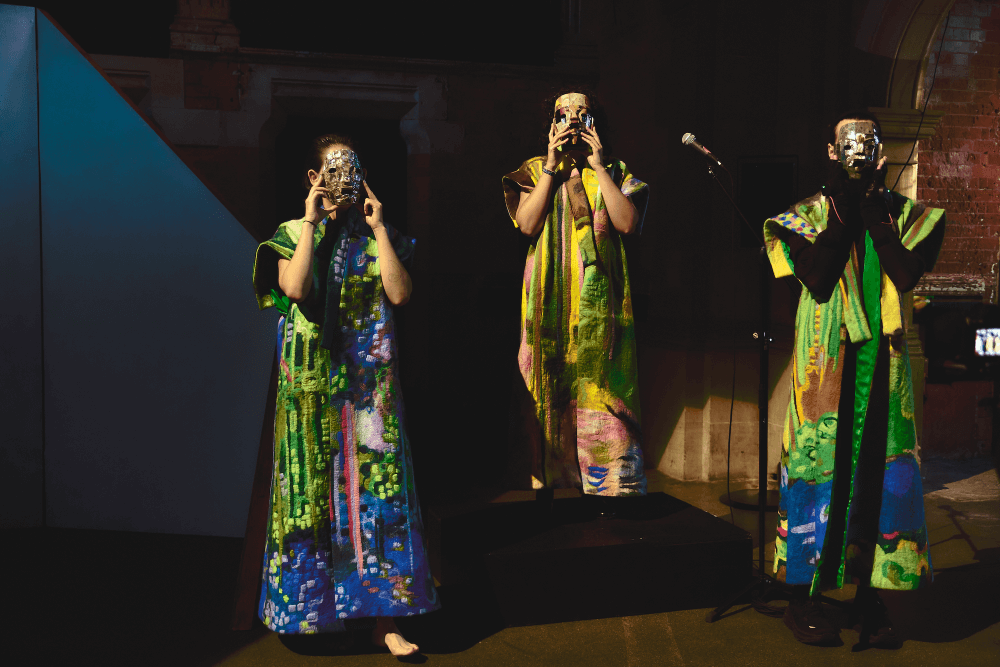
The Cenote Ring performance at Stone Nest by Paola Estrella. Photo credit: Stylian
Mexico’s cenotes – thousands of interconnected water-filled sinkholes – date back to the asteroid that caused the mass extinction of the dinosaurs. Millions of years later, and thousands of years before us, the Mayans found fresh drinking water and spiritual significance in the cenotes. In The Cenote Ring, artist Paola Estrella journeys through space and time with the cenotes, connecting us along the way to the cosmos, to history and myth and to speculative futures.
Like the cenotes dotted around the Yucatan peninsula – separate from each other yet connected – The Cenote Ring is comprised of two distinct parts that speak to and interact with each other. The first part is a collaborative performance which saw its first iteration at Stone Nest, London in May. The second part, on view June-December 2025 at HS Projects, presents the paintings at the heart of the project.
At Stone Nest, a lone singer welcomes us to another world, or is it our world in another time? The singer, María Mónica Gutiérrez (better known as Montañera), stands above us, like a priest at a pulpit or a DJ leading the masses in the former 19th-century church turned hedonistic 1980s night club turned squatters retreat turned experimental art space. Montañera’s sonic exploration builds slowly. Her ethereal cantations evoke both an ancient, common human past and a futuristic post-digital age.
With Montañera’s music setting the scene, we are at once worshippers in Paola’s chapel of human history, ravers embracing how technology can make us dance, and squatters looking for shelter in our vast universe. There is an understated genius to Paola choosing Stone Nest as the venue for her debut performance of The Cenote Ring, with its storied past layering itself into how we experience the piece.
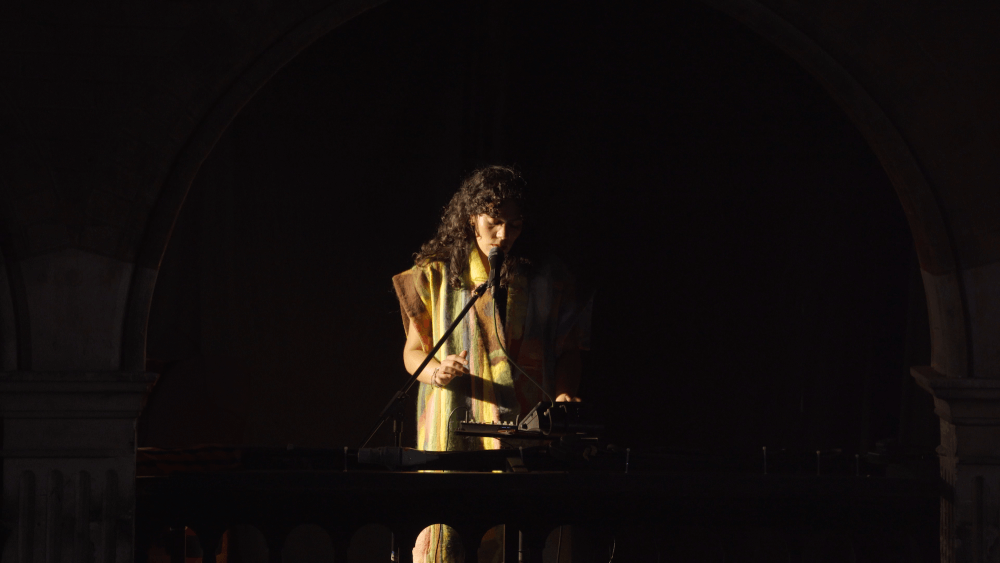
Montañera in The Cenote Ring. Photo credit: Stylian
Paola jolts us out of the trance Montañera’s singing lulled us into. The music gives way to Paola’s spoken word. Her words flow between history and mysticism.
Paola speaks about the water that comes from our eyes, human tears that are part of the water cycle. Which of your tears were once the water that filled the cenotes? Which tears will become the water that your great-great-grandchildren will drink to quench their thirst? Paola goes deeper than this earthly cycle, poetically weaving her way to supernovas, where elements are created that then form gases, minerals, planets and life. This scientific fact feels magical and spiritual. The asteroid that created the cenotes brought the cosmos to earth again. All life is of the cosmos. While humans put ourselves at the top of the food chain and think of ourselves as the most advanced and intelligent life form, we share so much with the rest of the universe.
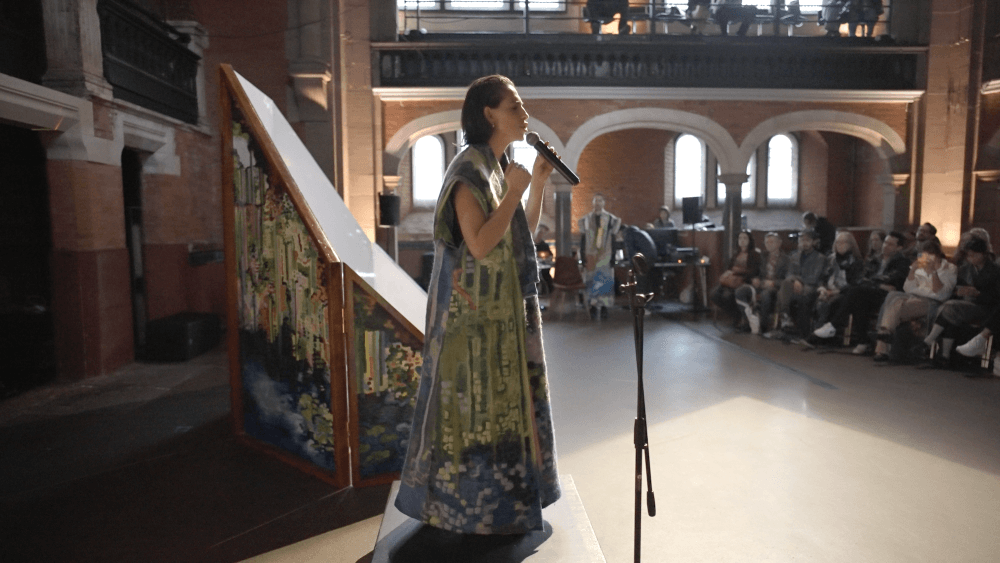
Paola Estrella in The Cenote Ring. Photo credit: Stylian
Throughout the performance, Paola engages with the contemporary tradition of magical realism. Futurism, fantasy and magical realism are present in her wider practice as well. This allows her to open imaginative spaces for reflection, what the artist calls “spaces where viewers can confront what exceeds the human experience and consider the roles that desire, belief, and myth play in shaping our lives.”
She goes on to explain, “I am drawn to magical realism, particularly because it reveals the porous boundary between the real and the imagined. This narrative mode resonates with my approach, where layered meanings and non-linear storytelling allow past, present, and future to coexist. In projects like The Cenote Ring, I weave together these timelines to explore origins, identity, and transcendence.”
Paola’s non-linear storytelling is encompassed in the multi-disciplinary nature of the performance. As she continues her spoken word piece, a video plays in the centre of the stage of the artist as a mermaid swimming in a cenote. Mermaids are symbols of love in some mythologies, but in others they are bad omens or conniving sea creatures who use their beauty to lure sailors to their death. In another scene, she lays in a shell-shaped fountain, reminiscent of the scallop shell in Boticelli’s Birth of Venus. Birth, life, death.
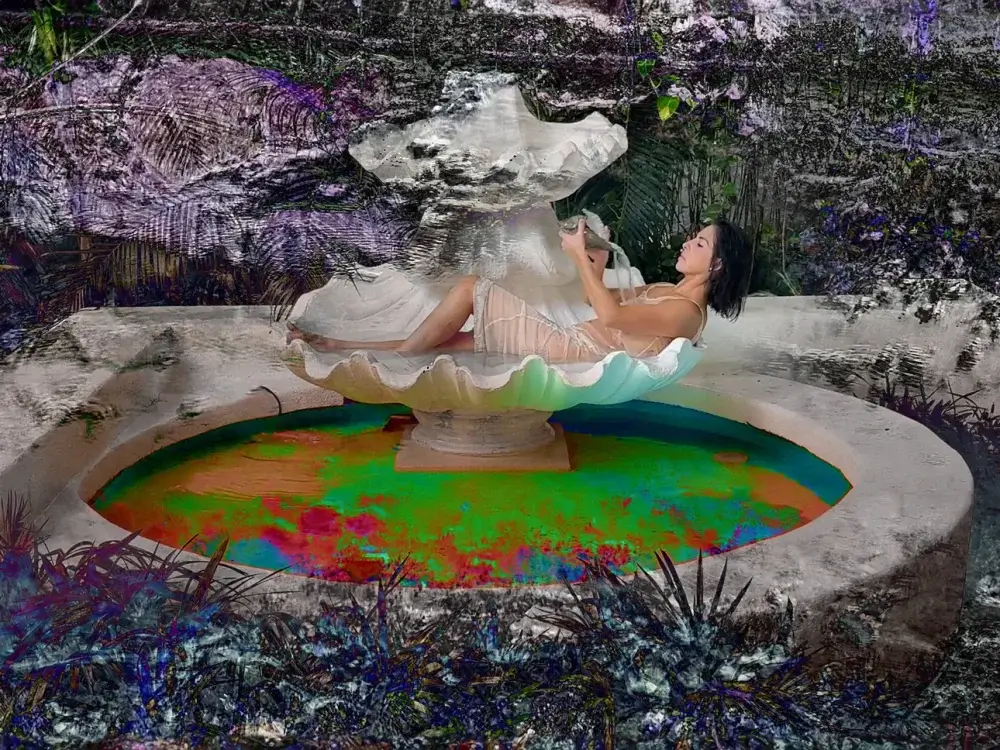
Still of the film The Cenote Ring by Paola Estrella
For the Mayans, the cenotes are a door to the underworld. Birth, life, death, underworld. The Mayans asked permission and made offerings before entering the cenotes to ensure their safety. Today, the cenotes are under threat from over development and the ecological crisis. What happens if the door to the underworld is destroyed? Birth, life, death, star dust. We go back to the universe from which we came.
Paola’s narration touches on themes of a pre- and post-human earth, technology vs spirituality, capitalism and expansion. Together, these hard-hitting concepts ease us into the most human question, one that has plagued our species for millennia: What is the reason for our existence?
Paola leaves us with that question as a cliffhanger. And spoken word moves again to music for the third and final act of the performance with choreographer Pierre Babbage and a soundscape by Bon Music Vision. The song that ensues, and the dancer, whose movement controls the movement of a futuristic humanoid character on screen, seems to punch us in the gut with the answer: art. Art, as a means of expression and spirituality, is what makes us human. It is what connects our historical past, from mystical beginnings, to our imagined futures, whatever that might mean in a post-capitalist technological age.
“Ultimately, my practice is invested in nurturing our capacity to imagine and innovate, a creative force that is vital to how we move forward as a species,” Paola explains to me later. Her curiosity about the future, present through the whole performance, comes fully to the surface in this third act. Technology is a tool, and Paola reminds us that tools can be used to build or destroy. The dancer, moving in a mirrored duet with the video game-like humanoid, hints at the tension between our analogue and digital worlds while suggesting that they can work in tandem.
The humanoid character is part of Costas Kazantzis’ contribution to the performance, a piece of handcrafted technology, a built 3D environment that presents a digital cenote world in shiny, liquid-y, chrome purples, blues, pinks, oranges and greens. If the cenotes are a portal to the underworld for the Mayans, for Paola they are portals to a speculative future. Spirituality meets technology, and Paola shows us that they can co-exist. Our future is not without magic. It’s a refreshing, optimistic take in comparison to so much commentary that presents our future as inevitably wrought and run by AI.

Still of 3D Environment by Costas Kazantzis in the film The Cenote Ring
The end of the performance is not the end of The Cenote Ring. Leaving the performance space, lights are focused on the back of the screen where the video component of the piece was projected. Paola’s painting of a cenote, a triptych on the back of the screen, is illuminated.
Paola renders the natural pools in a mix of saturated blue and hazy blue-greens. Cenotes are often extremely clear, with the limestone rock naturally filtering the water. However, some cenotes have hydrogen sulfide clouds formed where freshwater and saltwater layers meet. Divers describe these visible clouds or fog as other-worldly and eerie. At the top of the triptych, lush green vegetation and trees grow around the cenote’s rim. The world above is so bright that the sky is nearly white. Between these two layers, taking up most of the canvas, Paola plays with reality in how she depicts the limestone layer. An array of colours abstract the way that vines hang down into the cenote caves, where plants grow along the stone and where the caves’ stalactites and stalagmites form. Short dashes of colour, like pixels on a screen, give way to areas where the colour melts and flows down.
This triptych and her other cenote paintings form the visual language of the entire project.
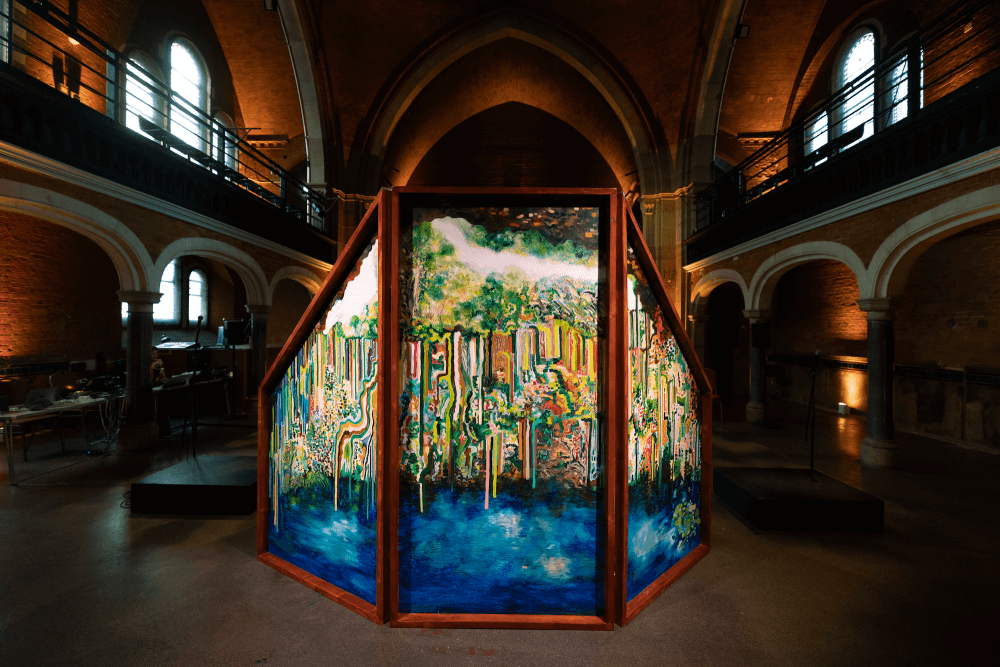
The Cenote Ring triptych
The second part of The Cenote Ring at HS Projects brings this triptych together Paola’s other cenote paintings. Each painting depicts a different cenote, all from the perspective of being inside the cave. The scale of the paintings gives the impression that the cenote is encircling us, embracing us even. Yet they aren’t so large as to lose their intimacy. Each cenote has a personality, and we get to know it on an individual level.
Though each unique, we must remember that cenotes are all connected to each other through underground bodies of water. When you affect one, you affect the others. The reverberations and connections of these cenotes echo throughout the project. In Paola’s practice, she often asks how painting can translate into three-dimensional spaces, between analogue and digital spaces. This parallel between cenotes being interconnected and Paola using painting to connect different facets of the project is no accident. The costumes that Paola and the other performers wore at Stone Nest bring the melting colours of Paola’s paintings into another medium and dimension. These floor-length robes, handcrafted in felt by Gabrielle Venguer in Mexico City, heighten the mystical aura of The Cenote Ring.
The huge windows at HS projects gives passers-by a glimpse into The Cenote Ring’s spirituality. I wish I could tell each one that they are witnessing our mythological past meet our imagined future. I want them all to know that we are connected to stars from billions of years ago and that everyone and every piece of Earth in the future will be connected to them.